
Scientific question first
What are we trying to test, and what evidence would actually support the claim?
A self-paced online cohort on Modern AI-Assisted In-Silico Drug Discovery Workflows: structure intelligence, protein curation, ligand preparation, multi-engine docking, AI-assisted scoring, pose validation, molecular dynamics design, MD interpretation, affinity thinking, and decision-making.
Real science, not protocol cloning.
Classical tools are still useful. Outdated habits are not.
From €49 · start anytime · full recordings, the DeepCADD AI tool & verifiable certificate included

Hands-on with the tools real computational labs use
Most weak in-silico workflows are not weak because the tools are bad. They are weak because the workflow is copied without enough scientific reasoning.
What are we trying to test, and what evidence would actually support the claim?
Docking scores, AI outputs, and MD plots are signals — not automatic proof.
Use classical and AI-assisted tools together with assumptions, controls, and uncertainty.
A practical map from scientific question to stronger computational evidence.
What are we trying to test?
UniProt · PDB · SIFTS · Literature
PDBFixer · MODELLER · Protonation
RDKit · Tautomers · Stereochemistry
Vina/Smina · GNINA · AI-assisted scoring
PoseBusters · ProLIF · Visual inspection
OpenMM/GROMACS · Waters/Ions · Replicas
MDAnalysis · Interaction persistence · Convergence
MM/PBSA carefully · OpenFE concepts · ADMET
Stronger evidence · Better decisions
Beginner-accessible, but not basic. The cohort starts with foundations and moves toward modern workflow design.
Docking foundations, MD basics, scoring limits, and common beginner mistakes.
PDB vs predicted structures, UniProt/PDB/SIFTS mapping, and uncertainty.
Protein repair logic, ligand states, RDKit preparation, multi-engine docking, and AI-assisted scoring.
Pose validation, interaction fingerprints, MD interpretation, affinity thinking, and decisions.
Select your access type in the registration form. Payment is handled securely after registration through Stripe. Access is delivered by email — there are no fixed dates, so you can start whenever suits you.
For students, PhD researchers, postdocs, and academic researchers. Full recordings, the DeepCADD AI tool, and a verifiable certificate.
Get accessFor industry, CRO, biotech, pharma, and professional researchers joining individually. Same materials and certificate.
Get accessFor labs, departments, and teams that want group access or a private session.
Request accessStructured, independent pages based on the DeepDrug AI visual concepts. Each article expands one principle behind the cohort.
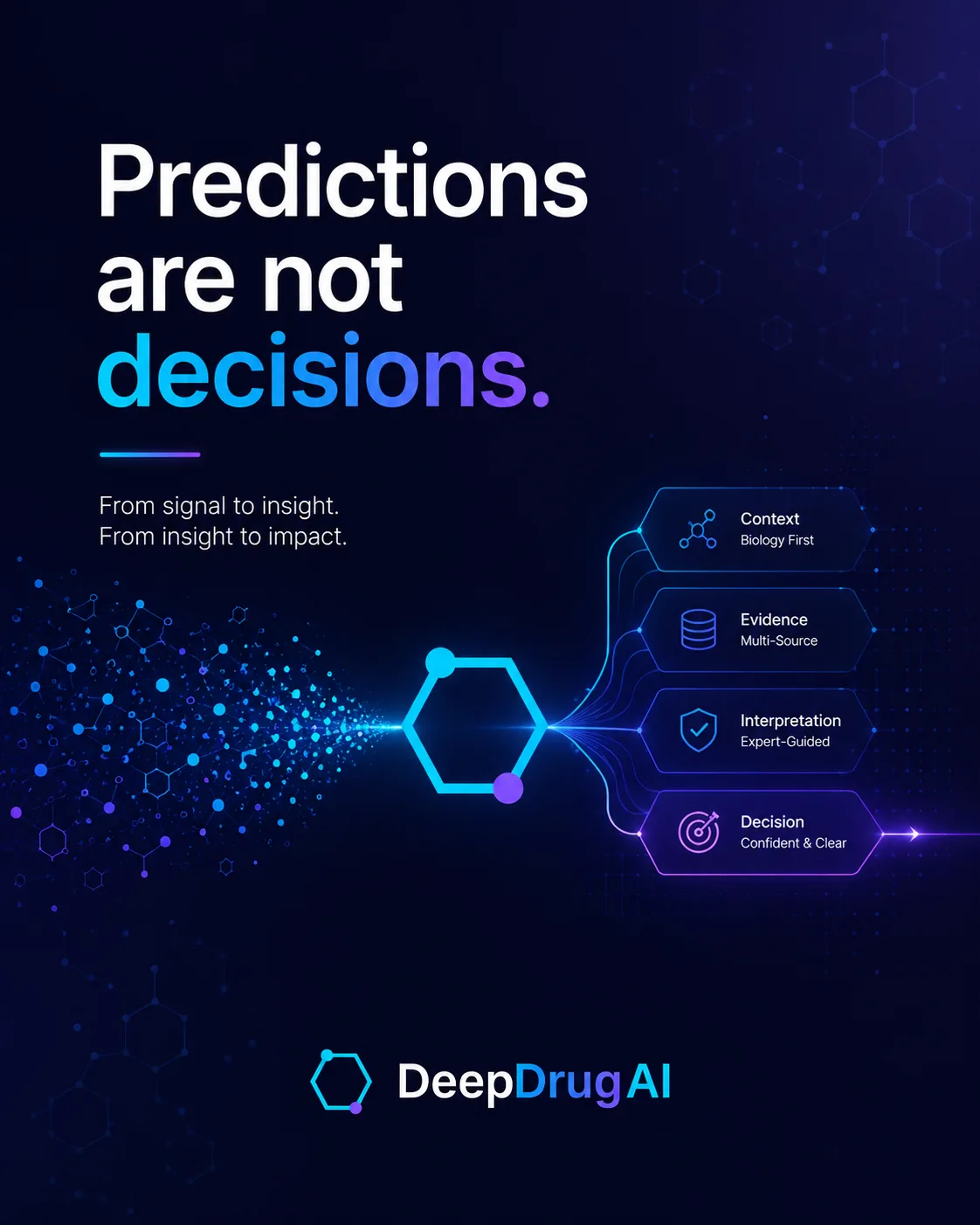
Predictions become useful only when they are connected to context, evidence, expert interpretation, and a justified decision.
Read article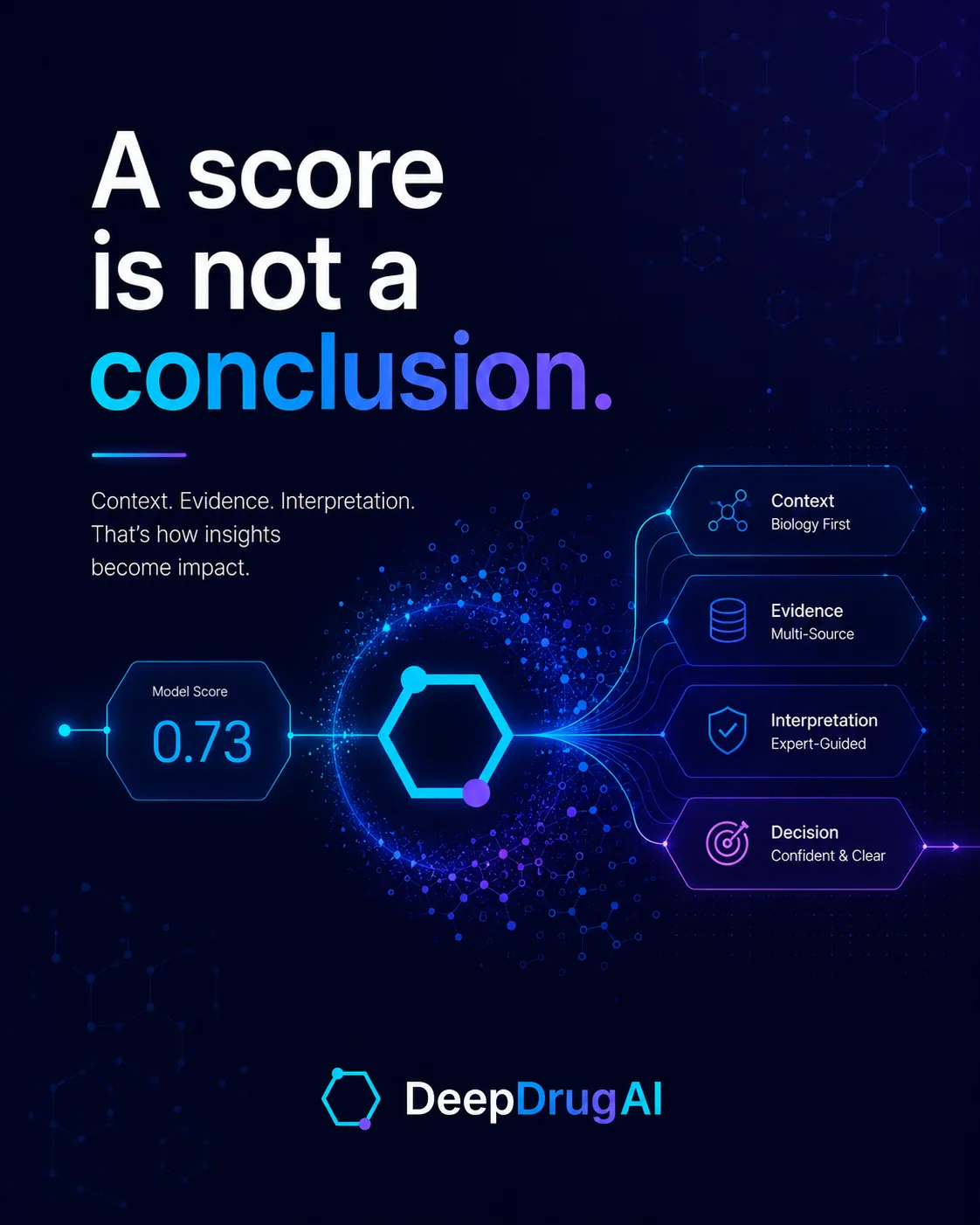
A docking or model score can help prioritize hypotheses, but it cannot replace chemical plausibility, biological context, and validation.
Read article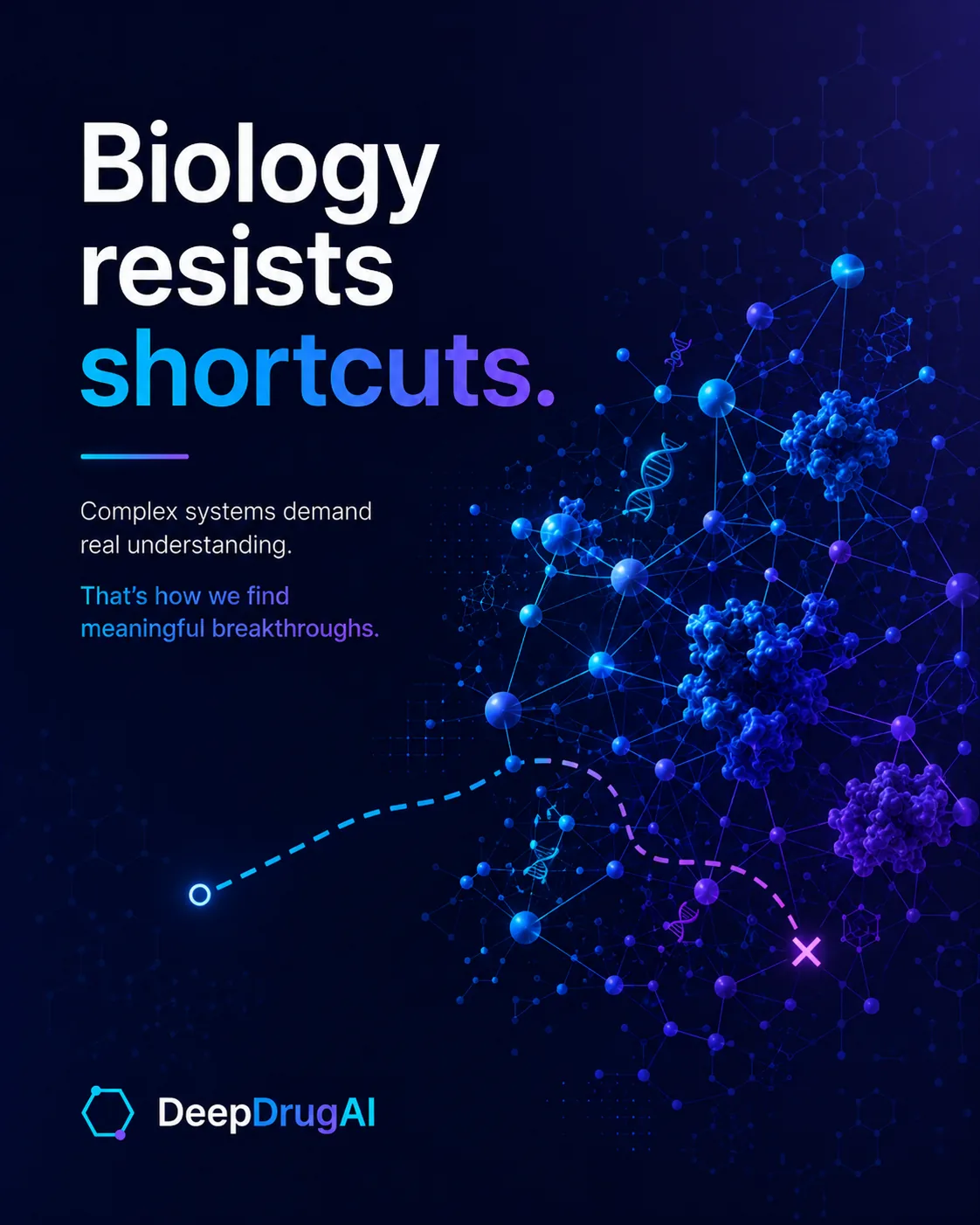
Biological systems are interdependent, contextual, and dynamic. Shortcuts fail when they ignore the system around the molecule.
Read articleBeginner-accessible, but not basic. It opens with an optional primer on what docking and MD actually predict, then builds toward modern validation, MD interpretation, affinity thinking, and decision-making. You start from foundations and move toward professional workflow reasoning.
Yes. You get a practical participant kit, not just lectures: setup guides, example datasets, reproducible notebooks, validation checklists, pose-review templates, MD interpretation templates, decision-report templates, and a certificate of completion.
The cohort deliberately teaches with open, industry-standard tools (RDKit, AutoDock Vina, OpenMM, GROMACS and more) so everything you learn transfers to your own lab and projects. The value is the workflow reasoning and validation discipline, not dependence on closed in-house software.
No advanced programming is required. The workflows use Python-based tools like RDKit, so light familiarity helps, but sessions are structured so you can follow the reasoning step by step, and the optional primer plus reproducible notebooks lower the entry barrier.
There are no fixed dates. The Summer Founding Cohort 2026 has been delivered, and the complete program is now available on demand: you register, receive access by email, and work through it at your own pace in your own time zone. Nothing to schedule, nothing to miss.
Recorded. Participants are spread across many time zones — for several, a live session would fall in the middle of the night — so the full workshop is delivered as recordings you can pause, repeat, and revisit as often as you like. A free one-to-one session is available if you want direct help with your own project.
Yes. You receive DeepCADD AI, our browser-based molecular docking workbench, together with a setup guide. It runs entirely on your own computer — nothing you load is uploaded — and the hands-on sections of the program are recorded inside it, so you can follow along step by step on your own machine.
Yes. You receive a DeepDrug AI Certificate for Modern AI-Assisted In-Silico Drug Discovery Workflows, carrying a unique certificate ID and a QR code. Anyone — an employer, a university, a funder — can confirm it independently on our certificate verification page.
Master's students, PhD researchers, postdocs, and early-career scientists, plus academic labs and professional teams working around pharmacy, biotech, medicinal chemistry, bioinformatics, computational biology, and drug discovery. You don't need to be advanced — just willing to think critically about tools, validation, and conclusions.
Complete the registration form and choose your access type. If you choose to pay now, you will be redirected to the correct Stripe payment page, and we'll email your access to the recordings, the DeepCADD AI tool, and your certificate details. There are no fixed dates — you can start whenever you like.